
The road to self-actualization: Meaning, benefits, and barriers explored

Many of us yearn for a deeper understanding of ourselves and a sense of fulfillment in our lives. But what does it really mean to reach our fullest potential? How do we navigate the path toward personal growth and fulfillment?
These are questions that have intrigued many over time. At the core of this quest lies the concept of self-actualization—a journey of exploration, introspection, and personal growth.
In this blog post, we look into the essence of self-actualization, drawing insights from psychology, coaching, and personal development. From its historical origins, we unravel the layers of self-actualization, exploring its significance in our lives and the challenges it presents.
Table of Contents
What Does Self-Actualization Mean?
Self-actualization, as defined by Oxford Reference, is about unlocking our full potential and deriving satisfaction from realizing our capabilities. An inner drive propels individuals to embrace challenges, shoulder responsibilities, and infuse creativity into their endeavours. This journey isn't about reaching a final destination but rather embracing continuous growth and understanding.
Drawing from the wisdom of Maslow's hierarchy of needs, self-actualization represents the pinnacle of human motivation. It's the desire for self-fulfillment, where individuals deepen their purpose, meaning, and creativity.
Trent Carter, a Nurse Practitioner and Founder of Curednation, emphasizes that "self-actualization is the process of becoming the best version of yourself and fulfilling your unique potential. People who are self-actualized tend to have higher levels of health and wellness, as they are more aware of their needs, strengths, and limitations. They also have a positive outlook on life, a sense of purpose, and a deep appreciation for themselves and others."
History & Perspectives
To understand self-actualization, we must trace its historical roots. Kurt Goldstein, laid the groundwork in the 1930s and 40s, viewing it as the ultimate goal for every organism—a drive for self-fulfillment inherent in humans, plants, and animals alike.
Building upon Goldstein's work, Maslow introduced the hierarchy of needs, simplifying the journey toward self-actualization through a pyramid of human needs. At the pyramid's base are psychological needs, and as they progress upward, safety, security, love, and self-esteem needs follow.
Only when these material needs find fulfillment can individuals focus on more spiritually inclined aspects, reaching the pinnacle – self-actualization. For Maslow, this represents the desire for self-fulfillment, where individuals deepen their purpose, meaning, and creativity.
In holistic coaching, as endorsed by the International Coaching Federation (ICF), self-actualization is approached by exploring the dimensions of 'who' and 'what.' The 'who' encompasses our entire being—our identity, experiences, values, and more—while the 'what' delves into our external aspirations and goals. By understanding both dimensions, holistic coaching offers a comprehensive approach to guide individuals toward self-realization and actualization.
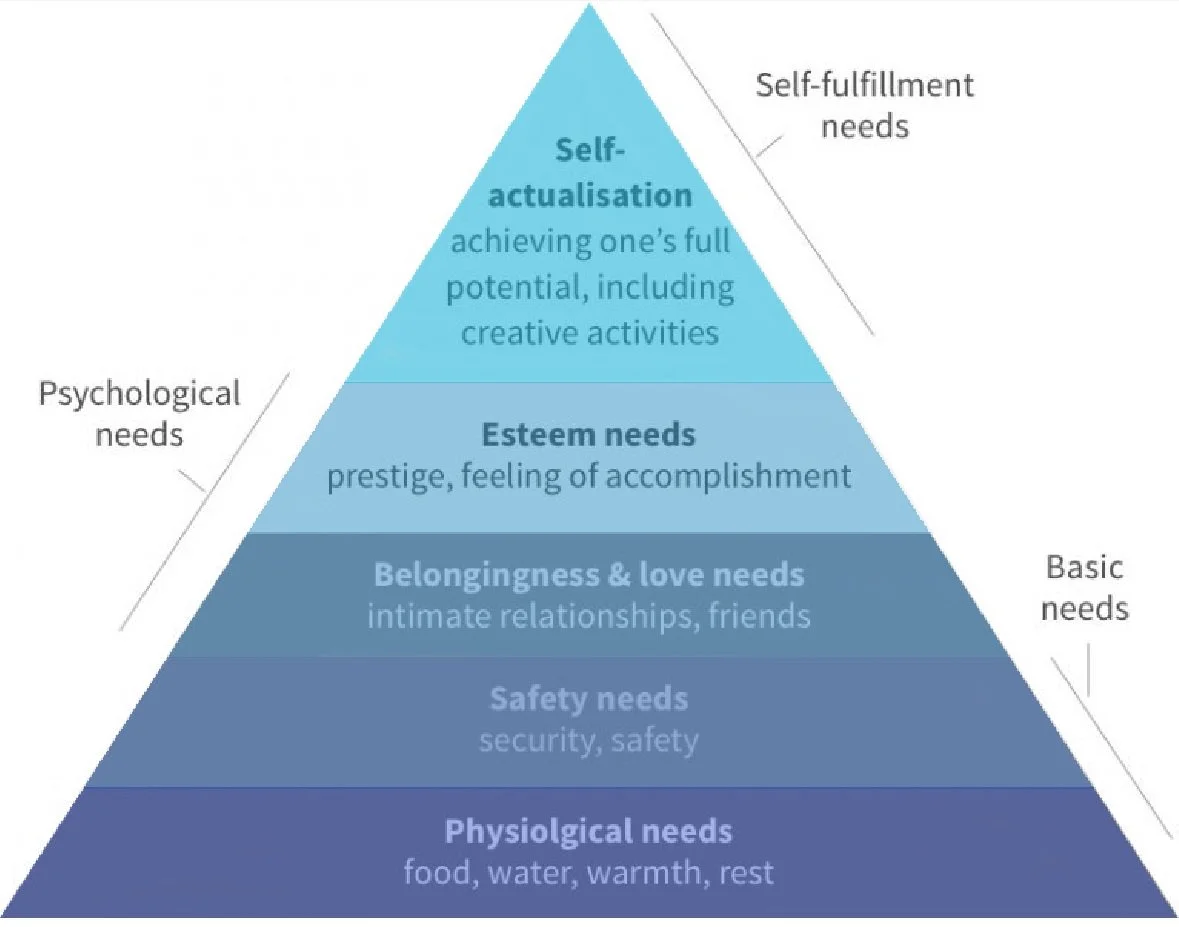
(Source: Wikimedia Commons)
Characteristics of a Self-Actualization Person
Having explored the essence of self-actualization from a psychology and coaching perspective, let's take a look at the characteristics and traits that define a self-actualized individual.
A self-actualized individual embodies profound self-awareness and connection with their identity, values, and beliefs. They express themselves authentically, fostering self-compassion, love, and acceptance.
This deep understanding of oneself translates into purposeful actions, where someone pursues their goals and ambitions with clarity and resilience. Through a consistent engagement with life, they find fulfillment in their endeavours, embracing setbacks as opportunities for growth.
Self-actualization has numerous benefits that enrich our lives and foster holistic well-being. Someone experiencing these benefits “have a strong sense of self-fulfillment and purpose, giving them a more positive outlook on life," notes Bayu Prihandito, Founder, Psychology Consultant, and Life Coach at Life Architekture.
He continues, “their understanding and acceptance of themselves help build their mental resilience and emotional stability. They're also more likely to engage in behaviours that promote physical health, like regular exercise and a balanced diet, driven by a deep sense of self-care."
Overcoming Barries and Challenges
As much as we may want to rush into self-actualization, it's important to understand that each step is crucial in Maslow’s Hierarchy of Needs. We move forward one step at a time, each serving as a necessary foundation for the next.
First and foremost, we address our basic needs—food, water, and shelter. These essentials are the foundation for survival, without which focusing on anything else is challenging. Once these are secured, we shift our focus to safety, seeking stability in our housing, employment, and health.
With our fundamental needs met, we turn to love and belonging, forging connections and finding support within our communities. Then, we nurture esteem, cultivate self-respect, and earn recognition from others.
Each step sets the stage for the next, creating a solid groundwork for self-actualization. Without addressing these needs, progress to self-actualized may pause, hindering our journey toward our truest, most purpose-filled selves.
Carter highlights the challenges inherent in self-actualization, "self-actualization is not easy to achieve, as there are many barriers that can hinder one's personal growth. Some of these barriers are external, such as a lack of basic needs, safety, or social support. Others are internal, such as fear of failure, low self-esteem, or incongruence between one's ideal and actual self."
To overcome any obstacles, Carter emphasizes cultivating a mindset of curiosity, openness, and acceptance, alongside actively seeking opportunities for learning, creativity, and self-expression.
Walking Your Path to Self-Actualization
As you continue on your journey of self-actualization, remember that this path is uniquely yours to navigate. With a deeper understanding of what self-actualization entails and armed with various approaches to guide you, I hope you feel empowered to keep moving toward fully realizing your true self.
The beauty of this pursuit lies not only in personal transformation but also in its positive impact on the world around you. As you unlock your unique gifts and share them with others, you contribute to a greater good. Your interactions, relationships, and influence become threads woven into a richer, more interconnected existence.
In pursuing your own fulfillment, you become a catalyst for positive change, inspiring others to embark on their own journeys of self-discovery and actualization. While the path may be personal, its impact extends far beyond the individual, shaping a tapestry of growth, understanding, and shared humanity.
Conclusion
In conclusion, self-actualization is not merely a destination but a continuous journey of growth and understanding so that we can express our highest selves into the world.
As we navigate the challenges and opportunities on this path, it's crucial to cultivate a mindset of curiosity, openness, and acceptance. By addressing our fundamental needs and nurturing our relationships, we lay the groundwork for personal growth and fulfillment.
For those seeking to reach their highest potential, life coaching offers a powerful way to map out desires and take consistent steps toward making them a reality.
I invite you to reach out for a complementary discovery call, if you're ready to take the next step on your self-actualization path. Let's embark on this journey together, unlocking your potential's fullness and embracing life's richness.
References
Oxford Reference. (n.d.). Retrieved January 28, 2024, from https://www.oxfordreference.com/display/10.1093/oi/authority.20110803100453144#:~:text=Self%2Dactualization%20encompasses%20the%20human,their%20technical%20or%20professional%20expertise
PCC Markers - International Coaching Federation. (2023, September 12). International Coaching Federation. Retrieved January 28, 2024, from https://coachingfederation.org/credentials-and-standards/performance-evaluations/pcc-markers
Holistic Coach Training Institute – ICF Accredited Holistic Coach Certification Program. (n.d.). Retrieved January 28, 2024, from https://holisticcoachtraininginstitute.com/
File:Maslow’s Hierarchy of Needs.jpg - Wikimedia Commons. (2019, April 10). Retrieved January 29, 2024, from https://commons.wikimedia.org/wiki/File:Maslow%27s_Hierarchy_of_Needs.jpg
Perera, A. (2024). Self-Actualization In Psychology: Theory, Examples & Characteristics. Simply Psychology. Retrieved January 30, 2024, from https://www.simplypsychology.org/self-actualization.html
Psychologist, J. S. B. (2023, April 26). What is Self-Actualization? Meaning, Theory + examples. PositivePsychology.com. Retrieved January 30, 2024, from https://positivepsychology.com/self-actualization
GoodTherapy Editor Team. (2019, March 15). Self–Actualization. Retrieved January 29, 2024, from https://www.goodtherapy.org/learn-about-therapy/issues/self-actualization







Explore the signs that you may be outgrowing your current role or career path, from shifting values and fading motivation to feeling pulled toward something new.